Welcome

Scouse Pie and Bovril is a blog dedicated to bringing you the latest on LFC, quality articles while mixing our passions for music, film, fashion, funny videos, photography & design.

Saturday, 16 November 2013

Igor Bišćan Hall of Fame #15

Welcome to my weekly blog “The Igor Bišćan Hall of Fame” every week I’ll be adding two new additions, one will be a Liverpool Legend or fans favourite, the other a Player, Manager or Club who have contributed to the world game we all love (Gary Neville need not worry). Please comment below who you’d like to see make the IBHoF, here are this weeks entries. YNWA


TERRY McDERMOTT

1974/75 - 1982/83

There were suspicions during Terry McDermott's early days at Anfield that he was destined to be a £170,000 misfit; he became instead a creative inspiration in one of the Reds' most exhilarating combinations. At his irresistible best he was the free spirit in a beautifully balanced midfield quartet led by anchor man Graeme Souness with Jimmy Case on the right flank and Ray Kennedy on the left. Terry's roving commission gave full rein to a potent cocktail of vision and stamina which prised open many of the world's tightest defences.

It was not always thus. Bob Paisley signed the Liverpool-born schemer from Newcastle in November 1974 after he had impressed against his home-town club in that year's FA Cup Final. Terry went straight into the side but failed to settle as the new manager experimented in an attempt to emulate the success of the Shankly era. When the trophies started rolling in, largely without Terry's assistance - Bob's Reds won the Championship and UEFA Cup in 1975/76 - it seemed likely that he would be written off as a mistake, albeit an expensive one, and unloaded.

But Paisley kept faith with the wiry ex-Magpie and when, in the following campaign, Liverpool were pushing for a squad-sapping treble, Terry began to blossom. After vying for a place with Case - whose stern tackling he could never remotely emulate - for most of the season, he became established in the spring and played a memorable part in a tumultuous run-in which saw the title and the European Cup end up at Anfield but the FA Cup slip away to Old Trafford. He was especially dangerous when running from deep positions and was adept at arriving late in the penalty area where his finishing, by turns powerful and subtle, could be deadly.

Terry's most valuable goal that term - and of his career, come to that - was the opener against Borussia Mönchengladbach in Rome where the Reds lifted Europe's top prize so gloriously. He ghosted, typically, down the inside-right channel to take a pass from Steve Heighway before clinically curling the ball past the German 'keeper. A month earlier there had been an even more mouth-watering piece of opportunism when Terry had spotted Everton's David Lawson off his line and chipped an exquisite goal in the FA Cup semi-final at Maine Road.

But the McDermott zenith was not reached until the arrival of Souness in 1978. The Scot's all-pervading influence on central midfield gave the newly-capped England international the liberty he needed to express his talents fully. A natural athlete, Terry made runs to all corners of the pitch, often acting as a decoy and creating space for colleagues to exploit, and when he did gain possession his instinctive control and incisive passing ability usually made the most of it.

He remained in his pomp for three years - in 1980 he was the first man to win awards from the football writers and his fellow players in the same season - and two incidents against Spurs during this period emphasise his dual value, as team man and individual. In September 1978 at Anfield he started and finished a flowing end-to-end move that capped a 7-0 annihilation, and 18 months later at White Hart Lane he decided an FA Cup quarter-final with a spontaneous flighted shot from near the corner flag.

Despite winning title and Milk Cup medals in 1981/82, Terry seemed to lose impetus and returned to Tyneside to help Kevin Keegan effect a Newcastle revival. That particular renaissance proved to be of the short-term variety, but when the two men were reunited at St James' Park a decade later - with Terry as assistant to manager Kevin - they trans­formed the Magpies into one of the most entertaining and dynamic sides of the nineties.


BORN: Kirkby, Liverpool. 8.12.51. GAMES: 310 (12). GOALS: 75.

CLUBS: Bury 69/70-72/3 (90, 8); Newcastle United 72/3-74/5 (56, 6) and 82/3-83/4 (74, 12); Cork City 84/5; Apoel, Cyprus.

HONOURS: European Cup 76/7, 77/8, 80/1. League Championship 76/7, 78/9, 79/80, 81/2. League Cup 80/1, 81/2.

INERNATIONAL CAREER: 25 England caps (77-82).


*************************************************************************************************************
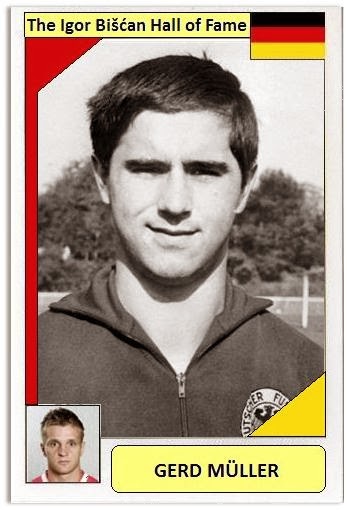


GERD MULLER

In 1964 Bayern Munich president Wilhelm Neudecker oversaw the signing of a promising young striker from TSV Nördlingen by the name of Gerd Müller. But the Bayern coach, Zlatko "Čik" Čajkovski, took one look at the new boy and sniffed: 'I can't put that little elephant in among my string of thoroughbreds.' Müller went on to spend almost sixteen years at Bayern, during which time he scored 365 goals in 427 League matches, helped his team to four Bundesliga titles and a hat-trick of European Cup successes. He also scored the goal that won the World Cup for West Germany in 1974.

In fairness to Čajkovski, Müller did not exactly look like someone who would turn into the most feared penalty box predator of his day. He was short and heavy with thighs that were as thick as tree trunks but his strength and low centre of gravity made him a real handful in the box where he could wriggle and dart free from his mountainous markers to find that precious yard of space so essential to all great goalscorers. He could turn on a sixpence and his reflexes were razor sharp with the result that 'Der Bomber', as he became known, rarely wasted an opportunity within eighteen yards of goal. Like Jimmy Greaves, he rarely bothered shooting from distance or picking the ball up in deep positions; all his work was done where it mattered. Yet whilst the vast majority of his goals were close range efforts, there was tremendous variety in his execution - bicycle kicks, diving headers, thundering volleys or simple tap-ins. They all came the same to Gerd Müller.

Although raised in a small village that had no football ground, Müller was always determined to make the grade and even as a youngster practised for hours on end, sharpening the skills that would stand him in good stead in years to come. These attributes brought him to the notice of Nördlingen who signed him in 1962 as a seventeen year-old. Two years later and he was off to Bayern where in 1966 he helped his new club secure the German Cup. He made his international debut that year in a 2-0 win over Turkey, but it was the following season that he really began to make a name for himself. His 28 goals made him top scorer in the Bundesliga - a feat he was to repeat in 1968, 1970,1972,1973,1974 (jointly) and 1978 - and he helped Bayern win the European Cup Winners' Cup with an extra-time victory over Glasgow Rangers in Nuremberg. As a result he was voted Germany's Footballer of the Year.

By the 1970 World Cup, the Germans had the luxury of two top-class but similar strikers in Müller and the veteran Uwe Seeler. Rather than have them competing for the same spot, the coach moved Seeler back into midfield. Both players scored in the quarter-final victory over England, Müller going on to finish top scorer in the tournament with ten goals, including a hat-trick against Bulgaria and two in the heartbreaking semi-final defeat to Italy. Accordingly he was named European Footballer of the Year-the first German to win the award. His stock increased with a match-winning brace in the final of the 1972 European Championships against the USSR and four more goals at the 1974 World Cup, among them a late semi-final winner to see off Poland and then the dramatic strike that lifted the trophy itself at the expense of Holland. His total of fourteen goals in World Cup finals matches remains a record. But he wasn't finished yet and in 1976 netted against Czechoslovakia in the final of the European Championships to become the first player to score in two finals of that competition. He retired from playing in 1981 with a career total of 628 goals in first-class football. Not bad for a 'little elephant'.


BORN: Nördlingen, Germany. 3.11.45.

CLUBS: 1963–1964 1861 Nördlingen, 1964–1979 Bayern Munich, 1979–1981 Fort Lauderdale Strikers.

INERNATIONAL CAREER: West Germany 1966-1974, Caps 62, Goals 68.


*************************************************************************************************************


The Igor Bišćan Hall of Fame welcomes you both. YNWA

Igor Bišćan Hall of Fame #14

Welcome to my weekly blog “The Igor Bišćan Hall of Fame” every week I’ll be adding two new additions, one will be a Liverpool Legend or fans favourite, the other a Player, Manager or Club who have contributed to the world game we all love (Gary Neville need not worry). This weeks addition is dedicated to Uruguayan fan rogerdodger99, Please comment below who you’d like to see make the IBHoF, here are this weeks entries. YNWA


JOHN ALDRIDGE

1986/87 - 1989/90

It was like a worthy but run-of-the-mill county cricketer taking over from prince of batsmen Viv Richards, or a rookie rider climbing into the saddle of master jockey Lester Piggott; when John Aldridge replaced Ian Rush as Liverpool centre-forward public expectations were not especially high. But Scouser John had the perfect response. He scored so freely that Ian was not missed and when the prodigal hero did return after a frustrating year in the Italian sun he found that reclaiming the role of the Reds' goalscorer-in-chief was no formality. Indeed, a hefty slice of the Welshman's first campaign back at Anfield was spent on the bench as he languished in the shadow of his so-called stand-in.

John had achieved his lifetime ambition of joining Liverpool in January 1987 when, with lan's departure in the offing, Kenny Dalglish signed him from Oxford United for £700,000. His Manor Ground strike-rate of around 1.5 goals every two games might have made him one of the most feared strikers in the land yet, strangely, there was widespread reticence in recognising his achievements. True, he had never played for a glamour club and his style was efficient rather than flashy, but that record – which included 18 months of First Division experience - would surely have made it surprising if he had failed at Anfield, instead of provoking the amazement in many quarters which followed his success.

In his first half-term as a Red, John started only two League matches but, significantly, scored in both, although it wasn't until 1987/88 that the headlines started coming his way. Even when he netted in the opening nine League matches - admittedly six of his strikes were from the penalty spot - he was accorded but a fraction of the acclaim deservedly bestowed on John Barnes. As the season wore on, however, it gradually dawned on the media that perhaps the unobtrusive front-runner who unfussily rounded off so many flowing moves should be given a share of the credit. After all, his finishing was clinical and he was better in the air than Rush; his selfless running created countless openings for Messrs Barnes and Beardsley and if John could match neither the ball skills of his team-mates nor the pace of his predecessor he made up for it with the positional sense of a born opportunist. Add to that his inbuilt passion for Liverpool - never more evident than in his utter devastation on missing his first penalty for the club in the 1988 FA Cup Final against Wimbledon - and his all-round value becomes apparent.

Despite the triumphs of his first full term at Anfield, in which he scored 26 times on the way to a title medal, it was widely predicted that he would quietly shuffle out of the limelight when Ian Rush returned for 1988/89. Once again John confounded the pundits. Ian spent most of the League opener against Charlton in the Selhurst Park dugout before replacing not Aldridge but Beardsley; John, meanwhile, was weighing in with a little matter of a hat-trick! That performance set the tone for a campaign in which 'Aldo' outscored an often unfit Ian and capped his Reds career by sweetly sweeping home the opening goal against Everton in the 1989 FA Cup Final.

Come 1989/90 it was clear that Dalglish must make a choice between the two men and, not surprisingly, he chose the one for whom he had paid more than £2 million. John, though, had one more moment of glory before joining Real Sociedad for £1 million. Just days before his September move, 'Pool were five up at home to Crystal Palace when they won a penalty and the Kop called for the Eire international. The boss betrayed evidence of a heart by sending him on, and he duly signed off with a goal; the man whom the critics had continually expected to fail had succeeded to the last.

Even then Aldo's Merseyside exploits were not finished. After two years of prospering in Spain, he signed for Tranmere as a 32-year-old in 1991, going on to register well in excess of a century of League strikes over the next seven campaigns. He became player-boss guiding them to a League Cup final at Wembley against Leicester City. Wherever he has played, at whatever level, John Aldridge has scored freely; it is tempting to wonder just what he might have achieved had he been allowed to remain at Anfield in 1989?


BORN: Liverpool, 18.9.58. GAMES: 88 (15). GOALS: 61.

CLUBS: Newport County 79/80-83/4 (170, 69); Oxford United 83/4-86/7 (114, 72); Real Sociedad 89/90-90/1 (63, 33); Tranmere Rovers 91/2-97/8. (242, 138).

HONOURS: League Championship 87/8. FA Cup 88/9.

INERNATIONAL CAREER: 69 Republic of Ireland caps (86-96), 19 Goals.


*************************************************************************************************************


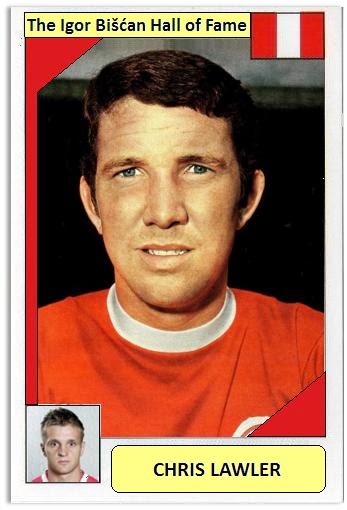
PENAROL

FULL NAME: Club Atlético Peñarol

CITY: Montevideo

COUNTRY: Uruguay

LEAGUE: Primera División

FOUNDED: 1891

STADIUM: Estadio Centenario (76,609)

COLOURS: Black, Gold

NICKNAMES: Aurinegros, Manyas, Carboneros, Mirasoles

RIVAL: Nacional

WEBSITE: peñarol.org


DESCIPTION:

The club that would someday be known as Peñarol were founded on September 28, 1891 as the Central Uruguay Railway Cricket Club. This was a club for workers and managers of the English-owned Central Uruguay Railway Company. As the name suggests the club played cricket but also football. Nine years later the club was involved in the formation of the first national association - the Uruguay Association Football League. In 1913 the club was reorganized and the football section broke off to form Club Atlético Peñarol, open to all members and not simply those involved with the railway company. Peñarol is the neighborhood of Montevidieo where the club is based. The full name translates as Peñarol Athletic Club and has sponsored teams in many sports over the years, although football is by far the most important.

The derby with Nacional, El Super Clasico, is one of the oldest in the world.

The 11 stars of the logo represent the 11 players in a team. The vertical black and gold stripes are seen at the front of railway cars throughout Uruguay. The nickname Aurinegros means The Gold and Black. The nickname Mirasoles refers again to the club colors. Mirasol (or more commonly girasol) means sunflower in Spanish. A carbonero is the train's fireman, the one who supplies the coal to a locomotive.

The nickname Manyas is quite a unique one. In the early part of the 20th century a player named Carlos Scarone (son of an Italian immigrant) began with Peñarol before emigrating to play in Buenos Aires for Racing. He later returned to Uruguay to play for Nacional and was asked by the press why he didn't return to Peñarol and he replied in a mix of Spanish and Italian - ¿A qué me iba a quedar en Peñarol?, ¿a mangiare mierda? which translates as "why would I go back to Peñarol? To eat s**t?". Mangiare became manyar in the Spanish/Italian mix of the city, the insult was turned on its head by Peñarol supporters and manyas became one of the most common nicknames for the club.


ESTADIO CENTENARIO:

Peñarol play most matches in the enormous Estadio Centenario, also used by arch-rival Nacional as well as the Uruguayan national team. The club also owns (and occasionally uses) a smaller stadium named the Estadio José Pedro Damiani - Las Acacias.


HONOURS:

Uruguayan Amateur Championship (1900, 1901, 1905, 1907, 1911, 1918, 1921, 1924, 1926, 1928, 1929)

Uruguayan League (1932, 1935, 1936, 1937, 1938, 1944, 1945, 1949, 1951, 1953, 1954, 1958, 1959, 1960, 1961, 1962, 1964, 1965, 1967, 1968, 1973, 1974, 1975, 1978, 1979, 1981, 1982, 1985, 1986, 1993, 1994, 1995, 1996, 1997, 1999, 2003, 2010


INTERNATIONAL TITLES:

Copa Libertadores (1960, 1961, 1966, 1982, 1987)

Intercontinental Cup (1961, 1966, 1982)

Supercopa (1969)


*************************************************************************************************************


The Igor Bišćan Hall of Fame welcomes you both. YNWA

Tuesday, 12 November 2013

Igor Bišćan Hall of Fame #13

Welcome to my weekly blog “The Igor Bišćan Hall of Fame” every week I’ll be adding two new additions, one will be a Liverpool Legend or fans favourite, the other a Player, Manager or Club who have contributed to the world game we all love (Gary Neville need not worry). Please comment below who you’d like to see make the IBHoF, here are this weeks entries. YNWA


CHRIS LAWLER

1962/63 - 1975/76

Chris Lawler was hardly an eye-catching performer, seeming to saunter through games with all the apparent urgency of a man out walking his dog. There was no swagger, no tricks, no histrionics, but in time opponents came to realise - often rue­fully, as they retrieved the ball from their net - that they ignored Liverpool's faithful right-back at their peril.

Not that his defensive capabilities weren't respected from the outset. It was obvious from early appearances deputising for centre-half Ron Yeats that the callow but composed Chris had all the qualities of a future back-four stalwart. No, what crept only gradually into the consciousness of opposing teams was an almost uncanny ability to ghost in behind his forwards and snatch goals when no threat seemed imminent. Presumably it was the result of instinctive anticipation, though sometimes it seemed like second sight.

The odd thing was that, unlike many defenders who pride themselves on finding the net, Chris was not a dead-ball specialist, never took penalties and did not possess a particularly powerful shot. Yet he can point to a career record of 61 goals, including ten in 1969/70 when he was the Reds' second-highest scorer and 11 in European competitions, which saw some of his most famous efforts. His most prolific continental campaign was that of the 1965/66 Cup Winners' Cup, in which he scored in three successive ties, starting with a deft header against Juventus before striking twice against Standard Liege and once against Honved.

Back in the First Division, Everton were twice the victims of the Lawler goal habit, both times at Anfield. In November 1970 Chris capped a stirring Liverpool comeback from a 2-0 deficit with a late winner and the following season scored with an overhead kick to complete a 4-0 rout.

Priceless though these attacking diversions were, Chris never allowed them to distract him from his primary responsibilities at the back. In fact, he fulfilled them so well that he missed only one League game between October 1965 and November 1973 - and that was when he was rested before the 1971 FA Cup Final. He first came to prominence in the 1963 semi final, slotting into the middle of a reshuffled defence alongside Yeats, and then earned widespread praise when he stood in for the skipper in three Easter victories during the title run-in a year later.

In 1964/65, when the ageing Ronnie Moran stepped down and Gerry Byrne switched to the left flank, Chris was handed the regular right-back berth. The slim, upright youngster took his chance with aplomb, underlining his progress by stifling the talents of speedy Leeds winger Albert Johanneson at Wembley and claiming a Cup-winner's medal. Calm, skilful and good in the air, Chris became a fixture and assisted in two Championship triumphs before a knee injury sustained at Loftus Road ended his proud record of consistency, effectively sidelining him for the rest of 1973/74. Despite a handful of appearances the following term he was never the same again and - after a move to Manchester City was called off by Liverpool at the last minute - he joined Portsmouth, later returning to Anfield for a coaching stint.

Chris's England outings were limited to four; there might have been more had he possessed a little extra pace. Some would point to competition from Keith Newton and Paul Madeley but Kopites would have none of it. For them the man they called 'The Silent Knight' - a reference to his quiet, modest nature - was simply the best right-back in the business.


BORN: Liverpool, 20.10.43. GAMES: 546. GOALS: 61.

CLUBS: Liverpool 62/3-75/6; Portsmouth 75/6-76/7 (36, 1); Stockport County 77/8 (36, 3).

HONOURS: UEFA Cup 72/3. League Championship 65/6, 72/3. FA Cup 64/5.

INERNATIONAL CAREER: 4 England caps (71).


*************************************************************************************************************


JOHN CHARLES

Nicknamed 'The Gentle Giant', John Charles was truly a colossus of the game, equally adept at playing centre forward or centre half. Indeed, the 42 League goals that he scored for Leeds United in 1953-54 (still a club record) came at a time when he was playing in defence for Wales. Yet his lasting fame is as British football's first major export to Italy where his achievements surpassed those of the illustrious names that followed him in the early sixties, including proven goalscorers such as Denis Law and Jimmy Greaves. Charles outshone them all, helping Juventus to three Italian Championships and two Italian Cups. He became a hero in a foreign land.

Born in Swansea, he joined the ground staff at his hometown club before moving to Leeds where he made his first-team debut in 1949. The following year he became the youngest player to appear for Wales when, at eighteen years and 71 days, he strode out against Northern Ireland. His record stood until Ryan Giggs stepped on to the international scene 42 years later. Charles was then a centre half but his powerful physique (he was 6ft 2in tall and weighed nearly fourteen stone) encouraged Leeds to try him out in attack as one of the big, bustling centre forwards that were in vogue at the time. His tremendous heading ability made him an instant success in his new role and by the time he signed for Juventus for a British record fee of £65,000 in 1957, he had scored 150 goals in just 297 appearances for Leeds.

Like George Best, the fact that he represented one of the lesser football nations denied Charles a prominent place on the world stage. Yet there was no denying Charles's pride in playing for Wales, whom he first captained in 1957. And the following year he helped his country reach the World Cup finals for the only time in their history. Exceeding all expectations, Wales drew their three group matches and beat Hungary in a play-off to reach the quarter-finals. There they met the eventual champions Brazil but, despite a gallant effort, Wales went down to a solitary goal from Pele. Significantly, Charles missed that match through injury.

Meanwhile, he was quickly becoming a huge favourite in Turin. The Italian game, built on the principles of a miserly defence, traditionally meant lean pickings for strikers yet Charles managed to score a remarkable 93 goals in 155 games for Juventus. The world's toughest defenders simply could not contain him.

By 1962 Charles and his family were missing home and he returned to Leeds for £53,000. However, he stayed just three months (scoring three times in 11 games) before surprisingly heading off back to Italy to join Roma for £70,000. Sadly, he was a shadow of his former self. That subtle first touch, unusual for such a big man, had deserted him and he had lost some of his pace and power. Sensing that Italian defences had finally got the measure of him, he once again answered the call of home and the following year he joined Cardiff City where he played alongside his younger brother Mel. John Charles retired from League football in 1966 at the end of an illustrious career during which he had averaged a goal every other game.

He briefly tried his hand at management with Hereford United but then drifted out of football altogether, as a publican and shopkeeper. If ever a man lived up to his nickname, it was Charles. For despite the intimidation to which he was subjected by defenders, he was never once sent off or even booked. And to this day he remains a hero, not just in his native Wales (for whom he was arguably their finest ever player), but also in a corner of Italy where he will forever be remembered as 'Il Buon Gigante' - the Gentle Giant.


BORN: Swansea, Wales. 27.12.31.

DIED: Wakefield, England. 21.2.04 (aged 72).

CLUBS: 1948–1957 Leeds United 297 (150), 1957–1962 Juventus 150 (93), 1962 Leeds United 11 (3), 1962–1963 Roma 10 (4), 1963–1966 Cardiff City 69 (18), 1966–1971 Hereford United 173 (80), 1972–1974 Merthyr Tydfil.

INERNATIONAL CAREER: Wales 1950–1965 Caps 38 Goals 15.


*************************************************************************************************************


The Igor Bišćan Hall of Fame welcomes you both. YNWA

Igor Bišćan Hall of Fame #12

Welcome to my weekly blog “The Igor Bišćan Hall of Fame” every week I’ll be adding two new additions, one will be a Liverpool Legend or fans favourite, the other a Player, Manager or Club who have contributed to the world game we all love (Gary Neville need not worry). Please comment below who you’d like to see make the IBHoF, here are this weeks entries. YNWA


EMLYN HUGHES

1966/67 - 1978/79

A new adjective should have been invented for Emlyn Hughes; nothing in the dictionary adequately captures the essence of a man possessed by an almost demonic fervour for football in general and Liverpool in particular. Enthusiastic, energetic, ebullient - they've all been used and deserve to be discarded. Ask his old Anfield team-mates and they'll tell you that mere words could never do justice to the man who led them to some of their most memorable triumphs.

Emlyn's arrival in February 1967 marked the beginning of the end of an era. Bill Shankly was making his first, tentative moves to dismantle his great sixties side and the bubbly Barrow boy, who made a handful of appearances at left-back in place of the injured Gerry Byrne before permanently replacing left-half Willie Stevenson for 1967/68, was the first newcomer to claim a regular place.

Shanks' admiration of the rookie Hughes began one spring day in 1966 when he watched the 18-year-old - who was to become, in the lurid language of the Reds' boss, 'one of the major signings of all time' - make his debut for Blackpool. Bill was so impressed that he made a £25,000 offer straight after the game but had to wait ten months before securing his quarry for £65,000.

Having moved to Merseyside, Emlyn wasted no time in making an impact. In his first game, at home to Stoke City, he dominated Potters' play-maker George Eastham and four matches later he earned a famous nickname. From the day he felled Newcastle forward Albert Bennett with a rugby tackle - nothing malicious, more an example of youthful impetuosity - Hughes was branded 'Crazy Horse', a label that was his for keeps.

Not that such eccentric acts were needed to draw attention to such a promising player, for whom Leeds were soon willing to offer Peter Lorimer in part-exchange. Built like a dreadnought and with strength to match, long-striding Emlyn rampaged around the football grounds of England like a frisky rhino. If subtlety was lacking in his early approach, and if he did occasionally commit himself to rash tackles, his vast potential was always evident. Left-sided but good with both feet, strong in the air and boisterously inspirational, Emlyn became known for his dynamic surges into enemy territory. Southampton were on the receiving end at Anfield in April 1971 when he broke up an attack in front of his own goal, played the ball wide and steamed up the centre of the pitch. Arriving with uncheckable impetus on the edge of the Saints' box, he cracked a first-time shot into the net. Irresistible!

In 1973/74 Emlyn replaced Tommy Smith as captain and moved into the centre of defence, forming an enterprising partnership with Phil Thompson. By this time his play had matured, his approach calmer and more reliant on anticipation than the buccaneering tactics of old. Though not as popular a skipper with team-mates as Smith or Yeats, Emlyn was a motivator supreme, leading by example and unflagging in his zest. In five seasons in charge he held aloft two European Cups, one UEFA Cup, two League Championship trophies and one FA Cup. At such moments his all-embracing grin - so familiar since his emergence as a TV person - was an emblem of Anfield ascendancy although, always one to wear his heart on his sleeve, he could also radiate utter dejection more thoroughly than most. None who saw him drag himself up Wembley's 39 steps to accept an FA Cup loser's medal in 1977 will forget his despair.

Emlyn - who at the time won more England caps as a Red than anyone else - was an emotional performer and a magnificent one. When he moved to Molyneux it was no surprise that he helped Wolves to League Cup glory. Somehow, though, that grin looked out of place above an old-gold shirt...

He had a spell as player-manager at Rotherham United then played for Hull City, later becoming a director. He joined Mansfield Town briefly in 1983, but did not make any appearances for the Stags. Later that year he also turned out for Swansea City, with whom he brought his playing career to a close.

In 2003, it was announced that he was suffering from a brain tumour, for which he underwent surgery, radiotherapy and chemotherapy. Hughes continued to battle against the disease until his death at his home in Dore, Sheffield, at the age of 57.

A minute's silence was held the following evening at Anfield before Liverpool's game against Middlesbrough in the Carling Cup and was impeccably observed. The KOP later sang his song; “Come all without, come all within, you’ve not seen nothing like the Mighty Emlyn”.

There will only be one Crazy Horse.


BORN: Barrow, England. 28.8.47. GAMES: 657. GOALS: 48.

DIED: Sheffield, England. 9.11.04. (aged 57)

CLUBS: Blackpool 65/6-66/7 (28, 0); Liverpool 66/7-78/9; Wolverhampton Wanderers 79/80-80/1 (58, 2); Rotherham United (player-manager) 81/2-82/3 (56, 6); Hull City 82/3 (9, 0); Mansfield Town 83/4 (0, 0); Swansea City 83/4 (7, 0).

HONOURS: European Cup 76/7, 77/8. UEFA Cup 72/3, 75/6. League Championship 72/3, 75/6, 76/7, 78/9. FA Cup 73/4.

INERNATIONAL CAREER: 62 England caps (69-80).


*************************************************************************************************************


WILLIAM “DIXIE” DEAN

Statistics can be misleading, but not in the case of 'Dixie' Dean. He averaged over a goal a game for England, scored 349 League goals in 399 matches for Everton and in the 1927-28 season amassed a total of 60 First Division goals - a record that still stands and is unlikely ever to be beaten. What's more, he only played in 39 of the 42 League matches that season.

Dean - he apparently hated the nickname 'Dixie' and preferred to be known as William or Bill - started his career across the Mersey with Tranmere Rovers for whom he scored 27 goals in just 29 games. This alerted Everton who signed him in 1925 but his Goodison career was nearly over before it had begun when a motorcycle accident left him unconscious for 36 hours with serious head injuries. Happily he made a complete recovery and in just over a year was embarking on that record-breaking season - a third of his 60 goals coming from headers! Peerless in the air, he could also shoot hard with either foot and was a constant handful for defenders.

Going into the final match that season, at home to Arsenal, Dean needed three goals to snatch the scoring record from Middlesbrough's George Camsell who had scored 59 times in Division Two only the season before. To the delight of the Everton crowd, Dean responded with a hat-trick - one of 34 he would score in his career, the most ever by a British player. He also scored 22 goals in other matches that season (three in FA Cup ties, 19 in representative games), bringing his overall total to 82.

Not surprisingly Dean's phenomenal goal haul helped Everton lift the First Division Championship. Even when Everton were relegated two years later, he netted 23 times in 25 games. His 37 goals in 1930-31, including a run of scoring in twelve successive League matches, enabled Everton to bounce back at the first attempt. The following season Dean was again rampant, his 45 goals firing Everton to another League Championship. In 1933 he won a Cup Winners' medal, scoring four times on the way to Wembley and another in the final itself as Manchester City were humbled 3-0. His favourite stage was a Merseyside derby and only Ian Rush has surpassed his total of nineteen goals in matches against Liverpool. Curiously, he scored his 200th League goal at the age of 23 years and 290 days - exactly the same age as Jimmy Greaves was when he reached that milestone three decades later.

Dean made his international debut in 1927 against Scotland in Glasgow and scored both goals in England's 2-1 victory. He went on to score twelve times in his first five internationals with a sequence of 2, 3, 2, 2 and 3 - not a bad way to begin a career at international level. He played his final game for England against Northern Ireland in 1933, the fact that he won a mere sixteen caps being a tribute to the wealth of talent that was around at the time.

By 1937 Dean's powers appeared to be on the wane and he was allowed to join Notts County but played only nine games before moving to Ireland where he helped Sligo Rovers reach the final of the Irish Cup.

He finally retired from playing in 1939, having scored 379 League goals in 437 matches. A jovial character who enjoyed banter with team-mates and opponents alike, he went on to run a pub for fifteen years. He later worked as a security guard for Littlewoods Pools and then retired to live on the Wirral. He died in 1980, fittingly enough at Goodison Park after collapsing while watching the derby match with Liverpool.


BORN: Birkenhead, England. 22.1.07

DIED: 1.4.80. (aged 73)

CLUBS: 1923–1925 Tranmere Rovers, 1925–1937 Everton, 1938–1939 Notts County, 1939 Sligo Rovers, 1940 Hurst.

INERNATIONAL CAREER: England 1927-1933, Caps 16 Goals 18.


*************************************************************************************************************


The Igor Bišćan Hall of Fame welcomes you both. YNWA

Igor Bišćan Hall of Fame #11

Welcome to my weekly blog “The Igor Bišćan Hall of Fame” every week I’ll be adding two new additions, one will be a Liverpool Legend or fans favourite, the other a Player, Manager or Club who have contributed to the world game we all love (Gary Neville need not worry). Please comment below who you’d like to see make the IBHoF, here are this weeks entries. YNWA


RAY KENNEDY

1974/75 - 1981/82

Ray Kennedy was a rare bird, a deceptively talented individual whose inimitable contribution to one of Liverpool's most imperious sides made nonsense of any attempt to pigeon-hole him. Glib descriptions of a powerful midfielder – which he became at Anfield after years as a successful striker with Arsenal – failed dismally to do justice to his full, subtle range of distinctive abilities.

When Bill Shankly signed Ray for £180,000 in the summer of 1974 - his last act as the Reds' boss - he was rescuing a slightly overweight centre-forward, still eight days short of his 23rd birthday, who had seemingly lost his way after playing a crucial part in the Gunners' League and FA Cup double of 1970/71. The newcomer found himself in at the dawn of the Paisley era and, despite an irritating injury which kept him out of the season's first four League games, impressed Bob enough to oust John Toshack from his front-running role. There followed a sequence of 24 games in which Ray managed ten goals, but then he lost his place as the Welshman was recalled in a bid to find a winning blend.

The turning point, however, was not far away. Towards the end of the campaign Paisley began experimenting with the former Highbury man in a deep-lying position behind the Keegan-Toshack spearhead - and liked what he saw. By November 1975 Ray was installed on the left of midfield where he was to help Liverpool lift ten major honours in six years of almost uninterrupted triumph.

His value to the team was incalculable, his footballing qualities legion, and if he didn't quite catch the eye like a Souness or a McDermott, Ray had much to offer the connoisseur. Still not the most athletic of figures - though more streamlined than on his arrival - he had a delicate touch for such a big man; he was adept at shielding the ball, a legacy of his days as a striker, and his distribution was intelligent, swift and decisive. Like all top players who are short of pace, Ray read the game well and often changed the emphasis of an attack with a sweeping crossfield pass, but perhaps his deadliest attribute was a knack of lurking unobtrusively on the left flank before making a late run into the box to finish off a move at the far post.

In important matches, he habitually spent the early minutes lying deeper than usual, doing a containing job before allowing his attacking flair to blossom as the game wore on, and opponents fell victim to a false sense of security. This tendency was especially marked in European encounters, in which the England international contributed some of his most vital strikes. An 83rd-minute away goal to upset Bayern Munich in the 1981 European Cup semi-final and a fierce second-half volley to turn the tide against Bruges when the Belgians were two up in the 1976 UEFA Cup Final are just a couple that remain sharp in the memory.

Ultimately squeezed out of the side by the youthful challenge of Ronnie Whelan in December 1982, Ray joined John Toshack's colony of former Reds at Swansea for only £20,000 less than his purchase price. A brief stint at Hartlepool preceded a spell as a publican and a coaching appointment at Sunderland before it was revealed that he had Parkinson's disease, which he has battled with characteristic courage. Ray was voted in at No.28 on the 2006 poll 100 Players Who Shook The Kop. Shanks, as usual, encapsulated the essence of a footballer better than most when he said of Ray: 'He played in no-man's land in a world of his own but he gave the team balance. He had style and he reminded me of Matt Busby.


BORN: Seaton Delaval, Northumberland, 28.7.51 GAMES: 381 (3). GOALS: 72.

CLUBS: Arsenal 69/70-73/4 (158, 53); Liverpool 74/5-81/2; Swansea City 81/2-83/4 (42, 2); Hartlepool United 83/4 (23, 3).

HONOURS: European Cup 76/7, 77/8, 80/1. UEFA Cup 75/6. League Championship 75/6, 76/7, 78/9, 79/80, 81/2. League Cup 80/1.

INERNATIONAL CAREER: 17 England caps (76-80).


*************************************************************************************************************


JUAN SCHIAFFINO

Juan Schiaffino is generally regarded as the finest player ever to come out of Uruguay. Although only slightly built, he defied those who thought he would be crushed by some of the most rugged, intimidating defenders in world soccer and went on to become a highly accomplished inside-forward. In that role he was able to demonstrate his tremendous repertoire of passing, allied to a fierce shot, extraordinary vision and lightning speed.

Born in Montevideo, he broke into the Peñarol youth team as a seventeen-year-old and a year later had progressed to the first eleven. Ten days before his twentieth birthday he made his international debut against Argentina in the South American Championship, a competition which the Uruguayans went on to win. The 1950 World Cup was decided by a four-team pool rather than a final match. After 7-1 and 6-1 wins against Sweden and Spain respectively, Brazil (the tournament favourites and host nation) needed only a draw from their last game with Uruguay to win the World Cup.

By contrast Uruguay had only drawn 2-2 with Spain and stumbled to a 3-2 victory over Sweden and were consequently ranked 10-1 outsiders. Brazil were so confident that the Rio de Janeiro state governor proclaimed them as champions and they had a victory song written in advance. Any football song is a mistake but this one doubly so. Yet at first everything went according to the script and when Friaça put Brazil ahead just before half-time, the trophy appeared theirs for the taking. But, throwing caution to the wind, Uruguay fought back and Schiaffino equalised midway through the second half before setting up a dramatic winner for Chico Ghiggia with just eleven minutes left. Uruguay had won the World Cup for the second time, Schiaffino finishing on five goals.

Schiaffino was once again Uruguay's key player in the 1954 tournament. With him at his best, anything was possible but without him they struggled. He gave notice of his intentions by scoring against Czechoslovakia and then in the 4-2 victory over England as Uruguay advanced smoothly to the semi-finals. However, in the semi-final against Hungary, the Uruguayans were hampered by an injury to Schiaffino and were beaten 4-2 in extra-time - their first defeat in a World Cup match. Depleted and demoralised, they promptly lost to Austria in the third place play-off.

Later that year Schiaffino moved to AC Milan for a world record fee of £72,000, helping the club to three League Championships and the 1958 European Cup Final in Brussels where they lost 3-2 after extra-time to the all-conquering Real Madrid. Revelling in the big match atmosphere, Schiaffino scored one of the Milan goals. Six months after his transfer he played the first of four internationals for his adopted country, having been called up to boost Italy's World Cup qualifying campaign, but it ended in disappointment as they failed to reach the finals in Sweden. But he remains one of the few players to have appeared in World Cup matches for more than one country.

At the age of 34 he moved to AS Roma and spent two seasons in the Italian capital before retiring in 1962. Although the brain was as quick and incisive as ever, the legs were no longer as willing. After almost fifteen years away from the game, Schiaffino suddenly returned to the spotlight to take charge of his old club Peñarol in 1976 and later had a brief spell as the Uruguayan national coach. Sadly, the players failed to measure up to the coach's high standards.

A throwback to the old days of the scheming inside-forward, in his prime Schiaffino often appeared to be an artist among honest labourers. Uruguay may have produced thousands of players down the years but there was only Juan Schiaffino.


BORN: Montevideo, Uruguay. 28.7.25.

DIED: 13.11.02 (aged 77).

CLUBS: 1943–1954 Peñarol, 1954–1960 AC Milan, 1960–1962 AS Roma.

INERNATIONAL CAREER: 1946–1954 Uruguay Caps 21 Goals 8.  1954–1958 Italy Caps 4 Goals 0.


*************************************************************************************************************


The Igor Bišćan Hall of Fame welcomes you both. YNWA

Igor Bišćan Hall of Fame #10

Welcome to my weekly blog “The Igor Bišćan Hall of Fame” every week I’ll be adding two new additions, one will be a Liverpool Legend or fans favourite, the other a Player, Manager or Club who have contributed to the world game we all love (Gary Neville need not worry). Please comment below who you’d like to see make the IBHoF, here are this weeks entries. YNWA


ROGER HUNT

1959/60 - 1969/70

It was the night they dubbed him 'Sir Roger'. More than 60,000 people had sallied forth in torrential rain, forsaking the comforts of hearth and home to bid farewell to one of Liverpool's favourite sons. Never mind that he had left the club more than two years earlier; he would have a place in their hearts forever. It was the testimonial match for one of the all-time great goal-scorers and no one wanted to miss the party.

Those locked out on that emotional evening in April 1972, when Anfield's capacity stood at 56,000, were left to listen to the roars from within and reflect on the supreme importance of Roger Hunt to the Reds throughout the fabulously successful sixties - a decade in which his goals had been their staff of life.

Roger's rise was little less than meteoric after scoring on his debut - as a 21-year-old with only amateur football and five Central League games behind him – against Scun thorpe at Anfield in September 1959. He quickly secured a regular place, netting 21 times in 36 games. In 1961/62 his prolific partnership with Ian St John was born and Roger struck 41 times in 41 outings, including five hat-tricks, to play a crucial role in turning the Reds' promotion dream into reality. Division One didn't know what was about to hit it.

The next six years brought an avalanche of goals - 149 in a mere 229 League games, to be precise - and it's no coincidence that Liverpool won the Championship in Roger's two most prosperous campaigns. In fact in 1965/66, the season of their sec­ond title triumph, the Reds didn't lose a First Division match in which he scored.

But there was more to Roger Hunt and his value to Liverpool than mere statistics. The explosive shot, the sudden and destructive pace, the strength which made him so hard to dispossess and his phenomenal work-rate were all well known. Less appreciated, perhaps, were his accomplished but unflashy ball control, neat distribution, refusal to hide from the ball when things were not going his way and an agile soccer brain which might have made him effective in a deep-lying role.

Goal-getting, though, was his golden gift and he employed it to the full. Never afraid to miss, Roger scored spectacular goals and easy goals, those that he bludgeoned into the net, like the brutal volley that jolted Inter Milan in the 1965 European Cup semi-final at Anfield, and those that he caressed past the 'keeper, such as the subtle touch that deceived Manchester United's Alex Stepney at Old Trafford in 1968.

His England record - 18 goals in 34 games, which included only two defeats – was outstanding, though he never received due credit for that, perhaps because he replaced national hero Jimmy Greaves in the 1966 World Cup. That Roger was the least-lauded member of Alf Ramsey's team was the outrageous product of ignorance and bias, and it was scandalous that such a selfless player should be driven to end his England tenure voluntarily as a result of constant and often hysterical criticism.

Modest to a fault and even-tempered, Roger was a referee's dream. The only moment of controversy came in March 1969, when he was substituted in an FA Cup defeat by Leicester and hurled his shirt into the dugout in frustration - a wholly untypical incident. By then he had survived a post-World Cup dip in form to bounce back with a brief but bountiful liaison with Tony Hateley before his Liverpool days tailed off as Bill Shankly sought new faces to end a relatively lean period. In December 1969 the 31-year-old Roger moved to Bolton, the club he had supported as a boy, to close a career which had seen him smash the Reds' scoring record and bring unprecedented glory to the club. The fans loved him for it; a knighthood was the least they could offer...


BORN: Glazebury, Lancashire, 20.7.38. GAMES: 484 (5). GOALS: 285.

CLUBS: Bolton Wanderers 69/70-71/2 (76, 24).

HONOURS: League Championship 63/4, 65/6. Second Division Championship 61/2. FA Cup 64/5.

INERNATIONAL CAREER: 34 England caps (62-69).


*************************************************************************************************************


PELE

In 1958 South America's best-kept secret was unleashed upon the rest of the world. A lithe, agile seventeen-year-old burst into the World Cup, scoring a hat-trick for Brazil against France in the semi-final and following up with two more goals in the final against Sweden. Brazil were world champions and Edson Arantes do Nascimento was the talk of the town. The world would come to know him as Pelé.

Almost every poll of the world's greatest-ever footballers puts Pelé at the top. A staggering career total of 1,283 goals in 1,363 first-class matches, three times a World Cup winner, perpetrator of outrageous dummies on goalkeepers and shots from the half-way line, it's a no-contest. It wasn't just what Pelé did, but how he did it. He had magical passing and dribbling skills, breathtaking ball control, he had pace, he had strength and he was a deadly finisher. And he did it all with such grace and rhythm, playing football to a samba beat.

Born in Três Corações, Pelé spent an impoverished childhood in southern Brazil where he enjoyed the basics of soccer from an early age, often playing with a ball made out of old socks. His father, Dondhino, was a moderate centre forward with a minor league club and encouraged the boy's interest in the game but his mother wanted something better for him. Pelé was determined to step into his father's boots and dropped out of school at the age of nine to pursue his dream of becoming a professional footballer. While his father coached him in soccer, young Pelé earned money as a cobbler's apprentice.

Pelé's precocious skill came to the attention of former Brazilian international Waldemar de Brito who encouraged him to join Bauru, a club based in Sao Paulo. Then, in 1956, Pelé moved to Santos and over the next eighteen years he would help them win nine Brazilian Championships. He made his first League appearance at fifteen and in 1957 scored on his international debut against Argentina. But it was the 1958 World Cup that thrust him into the limelight, notably a brilliant goal in the final where he trapped a ball on his thigh in a packed penalty area, hooked it over his head, whirled round and volleyed it past the startled Swedish keeper.

He missed the 1962 World Cup Final after tearing a thigh muscle in the second match of the tournament and in 1966 the butchers of Portugal kicked him all over Goodison Park. Fortunately for lovers of the beautiful game, he was still around for 1970 even though, in the wake of his experiences in England, he had originally vowed never to play in another World Cup. The 1970 Brazil team was filled to the brim with flamboyant players but Pelé stood head and shoulders above them all. Having scored three goals en route to the final, he saved his best until last, scoring one (a powerful header) and laying on two more as Italy were crushed 4-1. It was a fitting swansong as shortly afterwards he retired from international football.

He played on with Santos for another four years (his 1,000th goal had been a penalty against Vasco da Gama in 1969) before deciding to retire at 34. Santos marked his passing by removing the famous No. 10 shirt from their line-up. It was an admission that nobody could compare with Pelé.

In 1975 he came out of retirement to play for New York Cosmos, staying for two years before adopting a role as a sporting ambassador. In 1994 he was appointed Brazil's Minister for Sport and was later named Athlete of the Century.

Pelé once said: 'I was born for soccer, just as Beethoven was born for music.' In other mouths this would have sounded arrogant; in Pelé's it was merely a statement of fact.


BORN: Três Corações, Brazil. 21.10.40.

CLUBS: 1954–1956 Bauru, 1956–1974 Santos, 1975–1977 New York Cosmos.

INERNATIONAL CAREER: Brazil, 1957–1971, Caps 92 Goals 77.


*************************************************************************************************************


The Igor Bišćan Hall of Fame welcomes you both. YNWA