Welcome to
my weekly blog “The Igor Bišćan Hall of Fame” every week I’ll be adding two new
additions, one will be a Liverpool Legend or fans favourite, the other a
Player, Manager or Club who have contributed to the world game we all love
(Gary Neville need not worry). Please comment below who you’d like to see make
the IBHoF, here are this weeks entries. YNWA
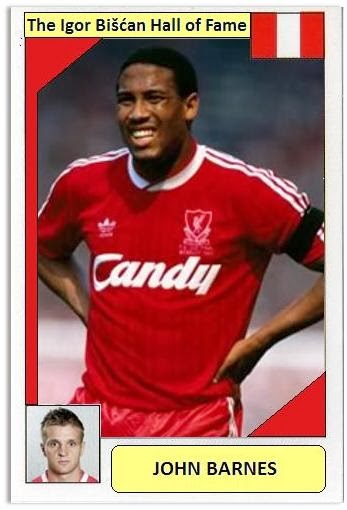
JOHN BARNES
1987/88 -
1996/97
As the
veteran John Barnes applied himself industriously to a comparatively
unspectacular midfield anchor role during the Reds' attempted mid-nineties
renaissance, it was inevitable that he was outshone by the generation of new
stars shining incandescently around him. But it should never be forgotten that,
not so long before, he had been hailed as one of the most brilliant
entertainers to grace British football since the war. More than that, he
achieved something which eluded every Anfield player before him: he became, for
a while, the national symbol of the game at its most attractive. In the same way
that George Best's name was once a byword for soccer excellence, even among
people who didn't follow sport, so in the late eighties was that of the
Jamaican-born England forward.
As an
all-round performer he did not equal Dalglish at his peak, and for sheer
pop-idol appeal, he did not match Keegan. But in terms of presence and charisma
John left the Scotsman standing, and for all Kevin's admirable qualities, he
lacked the magical skills with which the former Watford winger was so
plenteously endowed. Thus, it was John Barnes, more than anyone else, who
finally bestowed upon Liverpool the glitter and panache which had been the
traditional preserve of Spurs and our Manchester rival.
Yet for all
the plaudits heaped on his close-cropped head, John was seen as something of a
gamble when he headed north for £900,000 in the summer of 1987. His extravagant
talents were acknowledged, but at Vicarage Road these had been tempered with
inconsistency and there were fears that he was not the Anfield type. Any
misgivings, however, withered as John produced a string of scintillating early
performances which dazzled even the sceptics. To say he gave the Reds a new
dimension is a gross understatement. A big, powerful man blessed with a sublime
first touch, he was lethal when he received the ball in a deep left-flank
position and ran at defences. He had the guile to gull those who stood in his
way, the strength to ride tackles and a deceptive pace which took him loping
away from his stricken prey. One moment John would be hemmed in by several
opponents, two feints later he would be yards away, jockeying for a shooting
chance. And unlike many wingers, he could capitalise on his own approach work,
scoring goals from almost any angle or distance. Indeed, so stunning was his
marksmanship that some critics reckoned he was best employed as a central
striker.
John's
reward for his inspired efforts during that first Anfield campaign was a title
medal and Footballer of the Year awards from fellow professionals and soccer
writers alike. Understandably, much was expected of him in the 1988 European
Championships but he disappointed, as he did often in the international arena,
looking more like the wayward performer who had alternately thrilled and
frustrated in his Watford days. Maybe he needed his regular top-class
colleagues to bring the best out of him, for on his return to club duty he was
as deadly as ever, apart from the occasional game when he seemed to drift.
Despite his
catalogue of gifts, however, John experienced a relatively fallow career
interlude, which coincided loosely with the Souness reign. Injuries laid him
low and he put on weight, looking sluggish and ill at ease when he did play.
Happily, he shed pounds and regained vitality in 1994, confounding the popular
belief that he was finished, and became a subtly cohesive link-man, passing so
beautifully that he was known to go through an entire game without losing
possession.
Yes, there
were times when he was overrun by heel-snapping speedsters, and some reckoned
he was too cautious, not delivering enough 'killer' balls. There was no
denying, either, that the 'miracle man' of yesteryear had gone forever. But in
his place was a canny general, offering his precocious young lieutenants
much-needed guidance, sometimes with a firmness surprising in one so placid,
and it was clear that he had plenty to offer still. However, after he was
dropped for the Cup Winners' Cup semi-final second leg against Paris St-Germain
in April 1997, it became apparent that he was no longer wanted and come August,
by then aged 33, he was freed to pursue an Indian summer at Newcastle. It is to
be hoped that those fans who had noisily demanded his exit will now restore
him, in their minds, to the place of honour his service merits. Truly, John
Barnes was one of Liverpool's finest.
BORN:
Jamaica, 7.11.63. GAMES: 399 (4). GOALS: 106.
CLUBS:
Watford 81/2-86/7 (233, 65), Liverpool 87/8-96/7, Newcastle United 97/8-99 (26,
6), Charlton Athletic 99 (12, 0), Celtic (0, 0).
HONOURS:
League Championship 87/8, 89/90. FA Cup 88/9. League Cup 94/5.
INERNATIONAL
CAREER: 79 England caps (83-95).
*************************************************************************************************************

JOHAN CRUYFF
Among the
most enduring footballing images of the 1970’s was that of the Dutch master
Johan Cruyff standing out on the left wing, the ball at his feet, confronted by
a defender, but apparently unsure of his next move. In an instant he suddenly
dragged the ball behind him with his right foot, spun through 180 degrees and
sprinted away from his bewildered opponent. It was an outrageous trick, the
like of which had never been seen before on the international stage. Only the
most gifted - and most confident - of players would attempt such a feat. Cruyff
was not lacking in either commodity.
He was born
in Amsterdam where his mother worked as the original Ajax cleaner and it was
she who persuaded the club's coaches to admit her son into their youth
development scheme. On the recommendation of the English coach Vic Buckingham,
Ajax offered Cruyff professional terms in 1963. Not only did he score on his
club debut but he repeated the achievement in his first international in 1966,
snatching a last-minute equaliser against Hungary. Under the influence of new
coach Rinus Michels, Ajax developed into one of the most feared sides in Europe
with Cruyff, by now a supreme athlete, as the lynchpin of their attacking play.
The complete opposite of the traditional English battering ram centre forward,
he had vision, pace, exceptional ball control and a licence to roam. He helped
Ajax to a hat-trick of European Cup triumphs between 1971 and 1973 and was
voted European Footballer of the Year on an unprecedented three occasions
(1971, 1973 and 1974).
In 1973 he
moved to Barcelona for a world record fee of £922,000 and inspired his new team
to the Spanish League title in his first season, highlighted by a 5-0 win away
to arch rivals Real Madrid.
At
international level the Dutch were on the verge of greatness. Equally at home
in midfield, attack or on the wing, Cruyff embodied their philosophy of Total
Football, which allowed players to switch roles as circumstances dictated. He
was not one to hide his light under a bushel and, as captain, was the loudest
voice in an outspoken Dutch side. He had actually been banned from the national
team for a year after being sent off in only his second game for Holland but at
the 1974 World Cup he was determined to channel his energies in the right
direction. No defender in the tournament could get to grips with him. The Dutch
would have been popular winners of the World Cup but lost out in the final to
host nation West Germany. Cruyff was bitterly disappointed and retired from international
football before the next World Cup.
After a
spell in the North American Soccer League and then in Spain, he rejoined Ajax
and led them to two more League titles before making a shock move to their
fierce rivals Feyenoord whom he led to the League and Cup double in 1984.
With 215
Dutch League goals to his name, he took up coaching back at Ajax, and guided
the club to European Cup Winners' Cup success in 1987. Having walked out on
Ajax in a fit of pique, he replaced Terry Venables at Barcelona and captured a
remarkable eleven trophies in his eight years in charge, the highlight being
the club's eagerly-awaited first European Cup triumph. However, his dictatorial
style of management won him as many enemies as trophies and in 1996 he was
unceremoniously sacked. Cruyff was that rarity - a great player who became an
inspirational, innovative coach. In short, he was a total footballer.
BORN:
Amsterdam, Netherlands. 25.4.47.
CLUBS: 1964–1973 Ajax, 1973–1978 Barcelona,
1979–1980 Los Angeles Aztecs, 1980–1981 Washington Diplomats,1981 Levante,
1981–1983 Ajax, 1983–1984 Feyenoord.
INERNATIONAL
CAREER: Netherlands 1966–1977 Caps 48 Goals 33.
*************************************************************************************************************